If you have a business website, you’ve probably heard plenty about SEO (Search Engine Optimisation). Put simply, SEO is the process of helping search engines such as Google understand your website and making it more likely that your business will appear when potential customers search for the products or services you provide.
But there’s a new term appearing increasingly often: AI SEO, sometimes called AEO (Answer Engine Optimisation), or GEO (Generative Engine Optimisation)
So, what exactly is it – and is it something businesses need to worry about?
The way we search is changing
Traditionally, when you searched Google for something, you were presented with a list of websites. Good SEO was largely about making sure your website appeared as high up that list as possible.
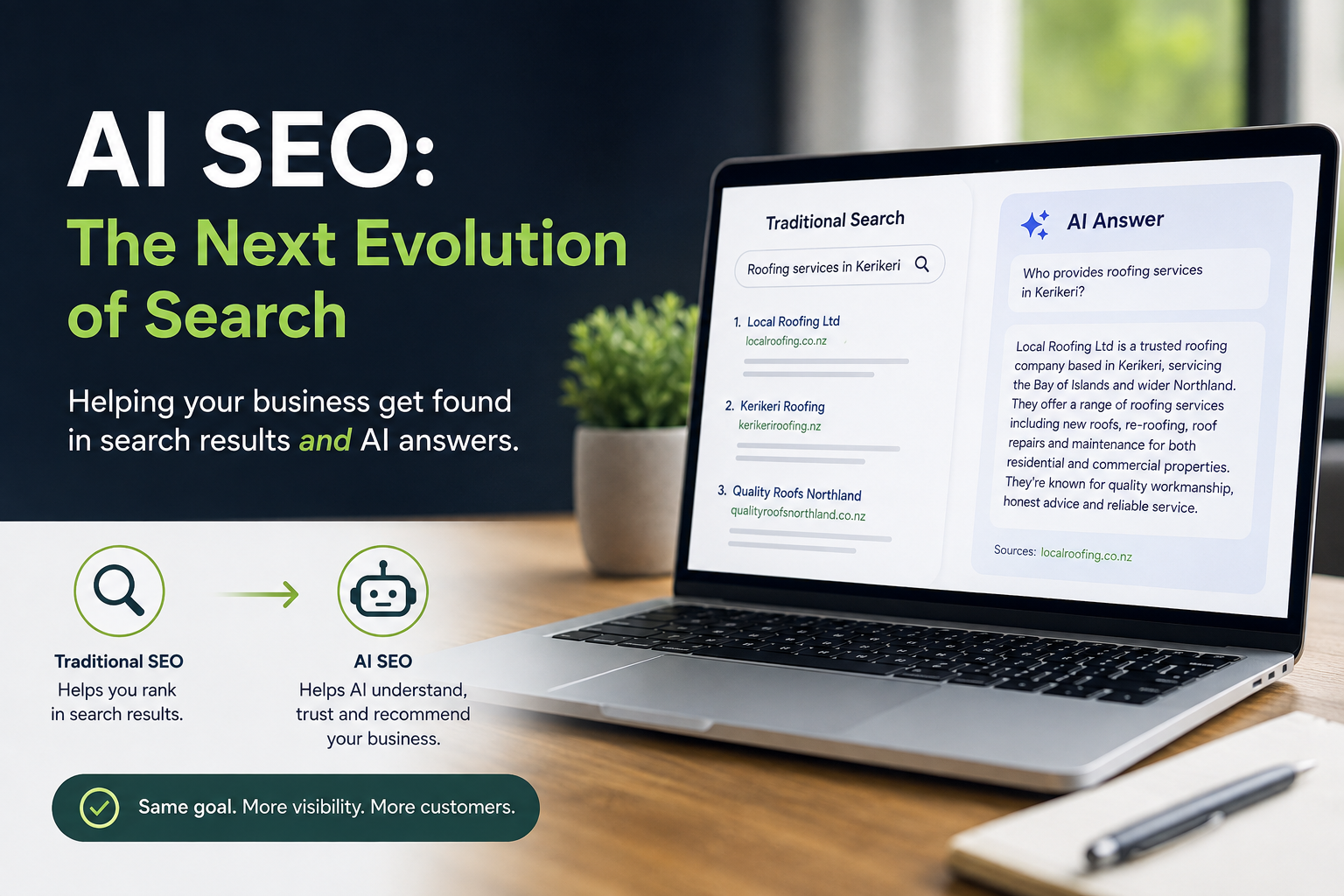
That’s beginning to change.
AI-powered search tools can now provide a direct answer to a question, drawing information from multiple sources across the internet. Instead of simply being given ten websites to choose from, users may receive a detailed answer, recommendation or summary.
That creates a new challenge for businesses.
It’s no longer just about getting your website into the search results. Increasingly, it’s also about making sure search engines and AI systems can clearly understand who you are, what you do, where you operate and why your information can be trusted.
That’s essentially what we mean by AI SEO.
You may also hear terms such as AEO (Answer Engine Optimisation) or GEO (Generative Engine Optimisation) used to describe the same developing area of search optimisation.
Is AEO completely different from normal SEO?
Thankfully, no.
Despite some of the hype surrounding AI, there is a considerable overlap between good traditional SEO and good AI optimisation.
A well-designed website should already clearly explain what a business does, contain useful and original information, have logically structured pages, use descriptive headings and make it easy for search engines to understand its content.
Those same qualities are valuable to AI search systems.
The difference is that we now need to think a little more about questions, context and clear answers, rather than simply concentrating on keywords.
Here’s a simple example:
Imagine you’re a roofing company operating in Kerikeri and the wider Bay of Islands.
Traditional SEO might involve creating a page called:
‘Roofing Services Kerikeri’
The page would explain the roofing services offered and naturally include relevant terms and locations.
That’s still good SEO and remains important.
However, we might now also include useful information answering questions potential customers are likely to ask, such as:
How much does a new roof cost in Kerikeri?
What roofing materials are best for coastal Northland properties?
Do you replace roofs throughout the Bay of Islands?
Providing clear, genuinely helpful answers to questions like these does two things.
Firstly, it gives potential customers useful information.
Secondly, it helps search engines and AI systems build a much clearer picture of the business: what it does, where it operates and what subjects it has expertise in.
It’s about making your business understandable
One of the best ways to think about AI SEO is that we’re helping computers understand a business in much the same way that we would explain it to another person.
We want them to understand:
- Who is this business?
- What products or services does it provide?
- Where does it operate?
- Who are its customers?
- What does it specialise in?
- What questions can it reliably answer?
- Why should its information be considered trustworthy?
The clearer and more consistent those answers are across your website, the easier it is for both traditional search engines and newer AI-powered systems to understand your business.
There are technical elements involved too. Good page structure, appropriate structured data (often called Schema), descriptive internal links, accessible website content and correctly configured business information can all help machines interpret a website accurately.
Does this mean traditional SEO is dead?
Definitely not.
Google search isn’t disappearing, and the fundamental principles behind good SEO haven’t suddenly become irrelevant.
In many respects, AI SEO is simply the next stage in the evolution of search optimisation.
Ten years ago, our objective might have been described as:
“Make it easy for Google to understand this page.”
Today, we’re increasingly thinking:
“Make it easy for search engines and AI systems to understand exactly who this organisation is, what it does, where it operates, what it knows and why its information should be trusted.”
That’s an evolution rather than a revolution.
Do small businesses need to do anything?
Yes – but there’s no reason to panic.
You certainly don’t need to rebuild your website simply because AI has arrived, and we’d be cautious about expensive services promising some magical form of “AI optimisation”.
Instead, businesses should begin incorporating AI search considerations into their normal website and SEO work.
That means creating websites with clear, well-structured and genuinely useful content; answering the questions customers actually ask; demonstrating real expertise; providing consistent information about the business; and ensuring the technical structure of the site helps search engines understand that information.
Most importantly, avoid the temptation to fill a website with large quantities of generic AI-generated content simply because producing it has become easy. Quality, originality and genuine knowledge of your subject are more valuable than ever.
SEO is changing – and that’s nothing new
Search engine optimisation has never stood still.
The techniques that worked 15 years ago aren’t necessarily the techniques we use today, and AI is simply the latest significant change in the way people find information online.
At GreenWeb, we’re increasingly looking at Search & AI Optimisation as part of the same process, ensuring websites aren’t just designed for the way people search today, but are well positioned for the way search is developing.
The objective hasn’t really changed. Help the right people find your business online. It’s simply the technology they use to find you that’s changing.
If you would like to know more about this subject or any of the other topics discussed on our website please drop us a line here. If you need images, aerial shots, video footage or VR tours for your next website project then please visit our sister company Bayofislands360.co.nz